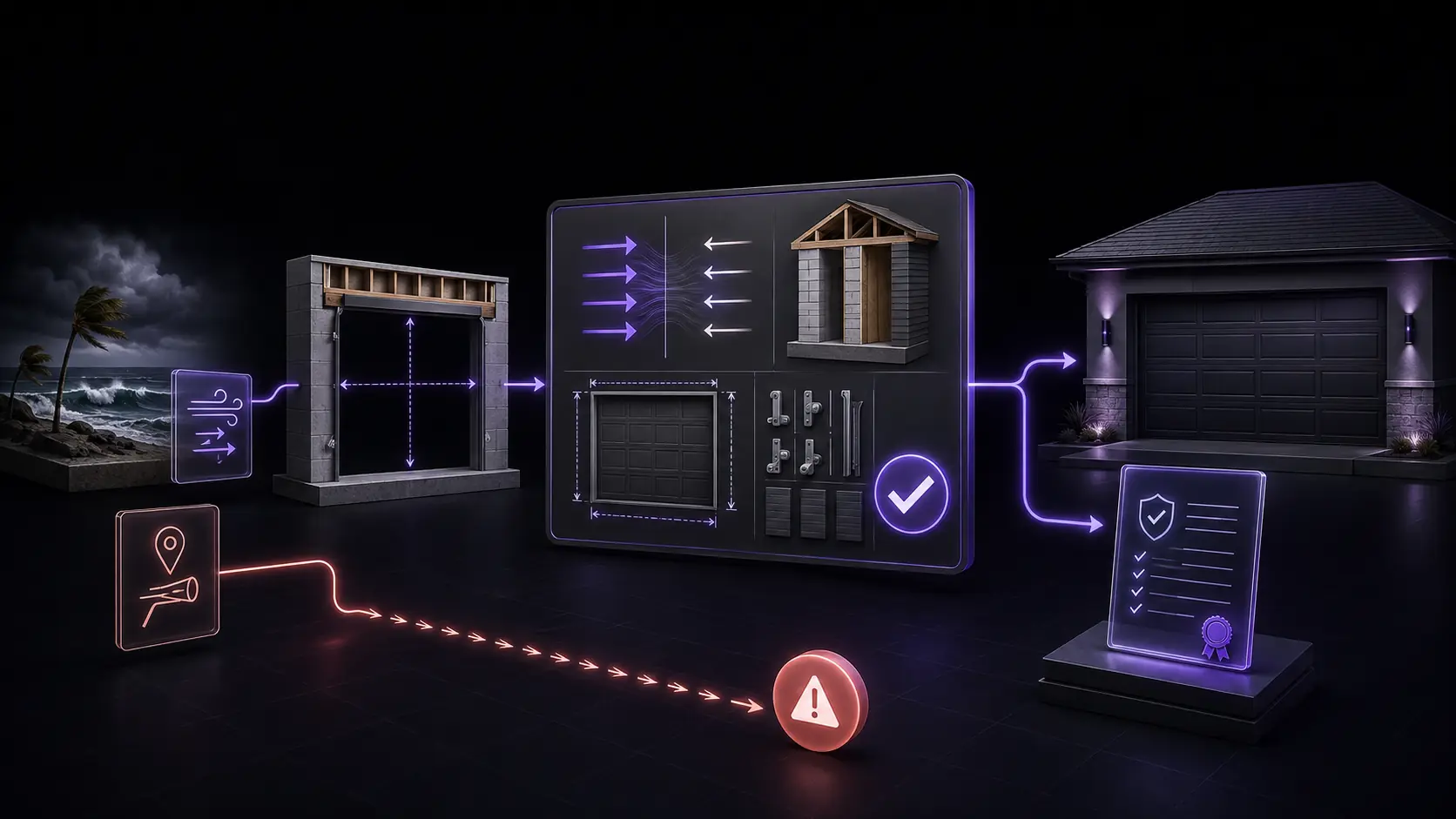
A homeowner asks for a hurricane-rated garage door. The website asks for a ZIP code, shows one wind-speed map, and promises the right door. That shortcut creates the wrong expectation before an estimator sees the opening. A useful wind-load page explains that the exact site, opening, design pressures, product configuration, supporting structure, and local approval path all matter—and turns that evidence into a qualified estimate.
01
The answer: qualify the opening before the product
A wind-load page should give a clear early answer: product suitability cannot be confirmed from a ZIP code, wind-speed number, or marketing badge alone. The page can explain the decision and collect useful project information, but the final selection should be based on current local requirements, the exact opening and building context, approved manufacturer documentation, professional measurement, and any required permit or inspection.
The International Code Council explains that design pressures can depend on wind speed, building height, occupancy, exposure category, and the door's position in the wall. It also describes label information such as positive and negative design pressure, model or series, test standard, and the referenced installation drawing. Those are project facts, not city-name modifiers.
EdgeLocal viewpoint: a wind-load page earns the right call when it narrows an evidence-heavy replacement decision without pretending the website can engineer it. Rankings for hurricane, high-wind, or code-compliant terms are incomplete if the resulting inquiry lacks the opening and approval information needed for a responsible estimate.
02
Do not convert one wind-speed number into a door promise
Miles per hour and pounds per square foot are not interchangeable product labels. DASMA's technical library includes guidance specifically addressing PSF versus MPH and separate wind-load guides tied to current model codes. The practical reason is visible in the ICC factors: required pressure is calculated from more than a basic wind-speed map. Two openings in the same broad market may require different decisions because their exposure, height, position, size, use, or governing requirements differ.
Clopay's wind-resistant door guide likewise treats wind maps as a starting point, directs buyers to the local building official, and distinguishes exposure categories plus positive and negative design pressure. A dealer page may summarize these concepts, but it should not publish a universal 'rated to X mph' promise unless the exact product documentation and applicable method support that statement.
Build the first form step around the property address, project type, and whether this is replacement or new construction. Then ask for approximate opening dimensions and optional photos for routing—not for remote structural approval. Use the estimate-form framework to keep intake useful without turning it into an engineering questionnaire.
03
Sell the installed assembly, not the label by itself
DASMA's updated TDS 181 says a final inspection should not rely on the wind-load label alone because products assembled or installed on site can be configured differently. Its checklist compares the approved drawing with the door size, reinforcement, stiles, hinges, rollers, brackets, fasteners, glazing, posts, jamb attachment, and other components. It also separates the door system from the adequacy of the supporting structure.
That changes the page's evidence standard. Show the exact manufacturer documents the company uses, explain that the quoted model and option package must match the approved configuration, and describe how professional measurement, installation, permitting, and inspection fit together in the markets actually served. Do not imply that a reinforcement kit, attractive label, or stronger-looking panel upgrades an incompatible opening after the fact.
Keep the safety boundary explicit. FEMA notes that garage doors can fail under wind pressure, while DASMA warns that spring and cable components are under extreme tension. The page should never coach homeowners to touch, adjust, brace, remove, or inspect high-tension hardware. Route damage and unsafe conditions to qualified professionals; the storm-damage guide owns that event-response journey.
04
Build one decision page for the real market
Start with one strong wind-load page when the company genuinely sells and installs approved systems across a coherent market. Explain the service territory, residential or commercial capability, professional assessment, product-documentation process, approval boundaries, and estimate path. Add jurisdiction-specific detail only where the company has real operating experience and materially different requirements or buyer questions.
Do not clone a thin page for every coastal city, county, subdivision, or wind-speed variation. Google's spam policies define doorway abuse to include substantially similar regional pages that funnel users to the same destination. Google's people-first guidance instead asks whether content demonstrates real expertise and helps the reader accomplish a goal. One evidence-rich page can outperform a directory of unsupported claims.
Connect the page to the wider buying journey. Link design and replacement questions to the replacement page guide, thermal questions to the insulation decision guide, and product-line evidence to the dealer brand-page framework. For commercial openings, route facility requirements through the commercial service-page playbook. Each page should own one decision rather than repeat the same wind paragraph.
05
Show the evidence a qualified buyer needs
A useful page can include an annotated example label, a plain-language positive-versus-negative pressure explanation, an exact-document checklist, original photos of completed closed-door installations with permission, and a short timeline from site assessment through product selection, permitting, installation, and inspection. Attribute every technical value to the exact product, drawing, configuration, and source date.
Separate design pressure, test pressure, impact resistance, and wind-driven-rain claims. They answer different questions. Do not infer impact approval from a wind rating, transfer a value between door sizes or glazing packages, or present a manufacturer's product approval as approval of an unnamed property. If a market requires project-specific engineering or authority review, say so plainly.
Use the Wind-Load Qualification Brief as the page's conversion asset. It tells office staff what to collect, gives the estimator a cleaner handoff, and lets a buyer see why a responsible answer takes more than a ZIP code. The CTA should offer professional assessment—not instant certification, guaranteed permit approval, or a universal product recommendation.
06
Measure qualified projects, not hurricane-keyword traffic
Track which wind-load queries and markets reach the page, but judge performance farther down the funnel: qualified calls, completed intake, measurements scheduled, openings that meet service and product criteria, quotes issued, permits or approvals completed where applicable, installations closed, and disqualification reasons. Record mismatches such as out-of-area requests, unsupported products, missing documentation, unsuitable structures, and repair inquiries that belong in a different workflow.
Review the page with estimators and installers whenever a product approval, model code, local amendment, service boundary, or manufacturer drawing changes. Confirm every linked document, label example, claim, image, form question, and jurisdiction reference. If buyers still arrive expecting a product to be selected from wind speed alone, the page has not done its job regardless of its traffic.
Reviewed August 17, 2026. ICC and DASMA support the design-pressure, label, drawing, component, supporting-structure, and inspection distinctions. FEMA supports the severe-wind risk context. Manufacturer guidance illustrates buyer and product-selection factors but does not approve any unnamed opening. Google supports the people-first and doorway-page boundaries. The Wind-Load Qualification Brief, page architecture, evidence handoff, internal-link model, and measurement plan are EdgeLocal analysis. Product suitability, permits, approvals, rankings, calls, estimates, jobs, and revenue are not guaranteed.
Sources and methodology
Sources checked for this guide
Source links support the platform, search, or safety facts stated above. The diagnostic framework and commercial recommendations are EdgeLocal analysis.
- DASMA: Technical Data Sheet library
- DASMA TDS 181: Garage Door Wind Load Guide for Building Officials
- ICC: Garage door provisions in the International Residential Code
- FEMA: Protect Your Property From Severe Winds
- Clopay: Guide to choosing a wind-resistant garage door
- Google Search Central: Creating helpful, reliable, people-first content
- Google Search Central: Spam policies for doorway abuse
Build a page that qualifies real projects
Turn wind-load searches into evidence-ready replacement estimates.
Bring your service market, current replacement page, product approvals, and estimator workflow to a focused strategy call. EdgeLocal will map the buyer questions, evidence, internal links, and qualification path worth publishing.
Book a strategy call