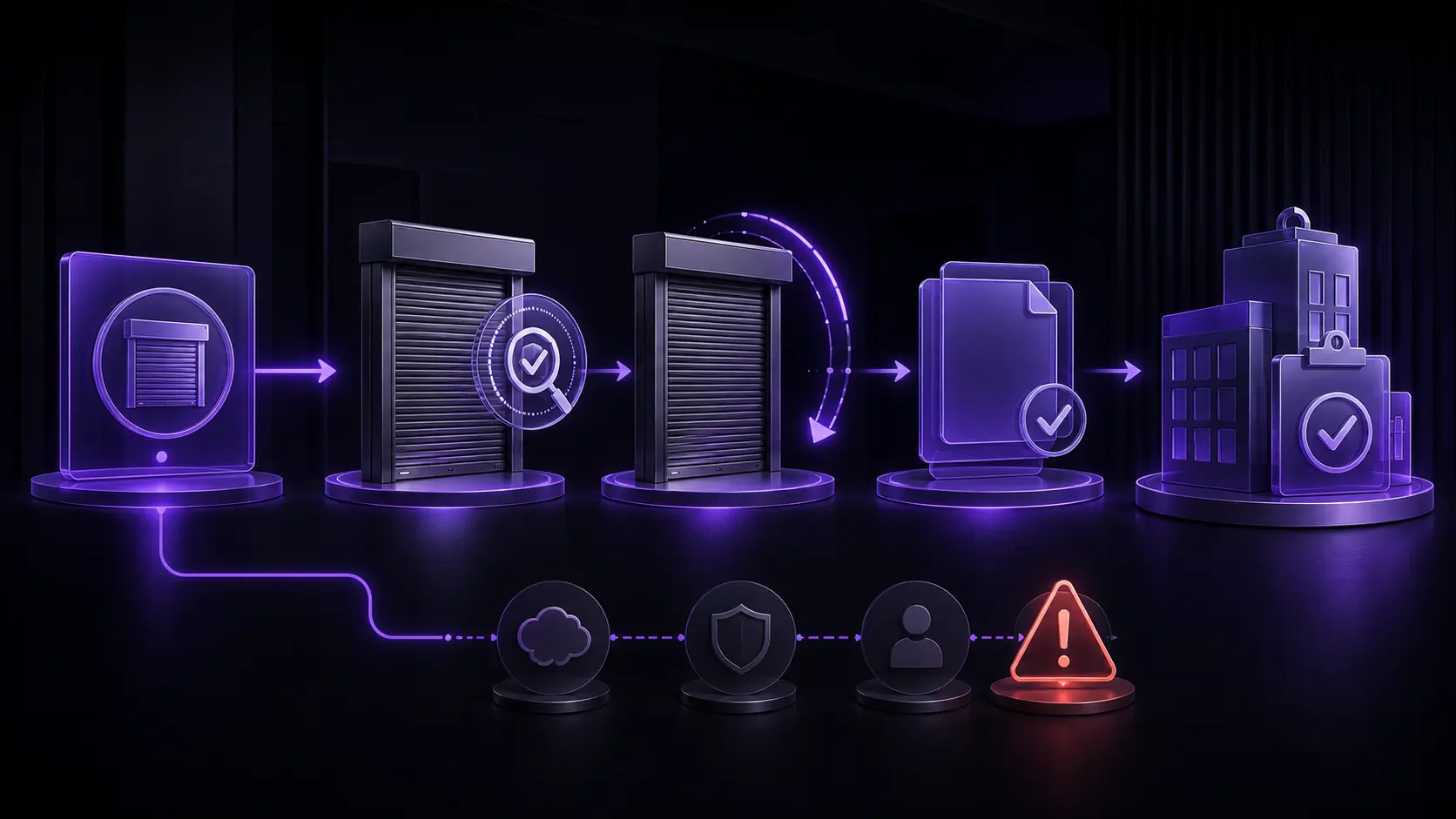
A facility manager searches for annual rolling fire door testing, but the contractor page says only ‘certified service’ and ‘full compliance.’ It does not identify the doors served, technician training evidence, records delivered, repair boundary, or territory. The buyer cannot verify fit, while the company risks promising an outcome controlled by the assembly, manufacturer instructions, adopted code, and authority having jurisdiction. A useful page sells documented capability and a clear service process—not a vague compliance badge.
01
The answer: market the evidence chain, not the word compliant
A rolling fire door page should answer six questions early: what assemblies and services the company handles, where it works, what technician basis supports the service, what information the facility must provide, what happens during the visit, and what record the buyer receives. If any answer varies by manufacturer, adopted code, facility, or authority having jurisdiction, say so plainly.
NFPA explains that rolling fire doors are inspected, tested, and maintained under NFPA 80. DASMA's current TDS 271 says doors should be inspected and drop-tested at least annually by a trained rolling steel fire door systems technician, with documented results. TDS 299 emphasizes documented training, owner responsibility, records, visible labels, defect correction, and manufacturer requirements.
EdgeLocal viewpoint: the valuable search result is not the page that repeats ‘NFPA 80 compliant’ most often. It is the page that helps a real facility manager determine whether this provider, technician, assembly, visit, and deliverable fit the job. Rankings without qualified opportunities are incomplete; qualified opportunities without verifiable capability are a risk.
02
Why generic fire-door pages create commercial friction
Facility buyers may manage warehouses, parking structures, hospitals, schools, kitchens, counters, or multi-site portfolios. A residential-style form asking only for a name, ZIP code, and ‘repair or replacement’ does not collect enough information to plan a rolling fire door visit.
The opposite failure is a technical wall of code language copied from a standard or manufacturer. It can confuse the buyer, age quickly, and imply authority the contractor does not own. The page should explain the business process in original language and link to the primary material that supports important requirements. Google's people-first guidance favors content created to help an intended audience, not pages assembled mainly to attract search visits.
Do not use an accreditation logo, certification phrase, technician count, manufacturer relationship, jurisdiction list, or response-time promise unless it is current and provable. Do not claim that a visit guarantees approval. DASMA states that ultimate acceptance is determined by the authority having jurisdiction. The contractor can inspect, test, document, maintain, repair, and communicate within its verified scope; it cannot pre-approve the building.
03
Build the page around the service sequence buyers need
Start with a direct scope statement. Separate inspection, operational testing, drop testing, maintenance, repair, retesting, and replacement instead of presenting one interchangeable package. State the door types and markets actually served. Link the broader commercial service page for non-fire-rated assets.
Describe the visit at a decision level, not as instructions a facility employee could imitate. DASMA's published sequence includes a pre-test visual inspection, operational test, first drop test, reset, and second drop test. Its separate TDS 252 warns that rolling fire door testing must begin from the fully open position and describes injury and damage risks when it does not. The marketing page should therefore say that trained personnel control and clear the work area, follow manufacturer instructions, document deficiencies, and perform the applicable test sequence. It should not teach the reader how to release, adjust, reset, or repair the assembly.
Show the deliverable: door identifier and location, manufacturer or label information when available, visual and operational findings, test result, deficiencies, corrective work authorized, retest status, technician and witness fields where applicable, and recommended follow-up. A blank sample report with fictional facility data removed can provide stronger proof than another stock image of a warehouse.
04
Qualify the asset before dispatch
Use a commercial intake path that asks for facility address, on-site contact, door count and locations, label and manufacturer photos, approximate sizes, operating method, last known test date, known damage, relevant release interface, access constraints, documentation, and scheduling restrictions. Make photos optional initially if upload friction would block contact.
The office should confirm whether the company serves that geography, whether the assembly falls inside its capability, whether trained personnel are available, whether manufacturer information is obtainable, and whether another licensed or specialized party must coordinate. For multi-site work, collect an asset register or schedule a portfolio scoping call instead of making the buyer complete the same form repeatedly.
Connect the page to the estimate-form framework, but add only the fields needed to avoid a wasted commercial visit. Use the lead-response system to assign ownership and status. A life-safety inquiry sitting in a general inbox is not a qualified workflow.
05
Prove capability without inventing authority
Use first-party evidence: technician training documentation, permitted job photos, an anonymized report sample, actual markets served, an honest repair-and-retest process, and a current contact path. Describe any manufacturer relationship exactly and follow its trademark rules.
Keep regulatory statements specific. NFPA's 2025 FAQ says NFPA 80 calls for inspection and testing after initial installation and at least annually thereafter. DASMA adds practical rolling-door guidance and training definitions. OSHA's warehouse guidance tells employers to keep safeguards such as fire doors in proper working order, while OSHA has also stated that it does not have a single overhead-door-specific standard. Those sources do not make every contractor a compliance authority and do not replace adopted local requirements.
Never publish unsafe do-it-yourself testing, adjustment, release, reset, spring, cable, or repair steps. DASMA's rolling-door evaluation guidance warns that counterbalance components remain under extreme spring tension and that improper repair or adjustment can cause severe injury or death. The safe public answer is to isolate the concern, avoid operating a questionable assembly, and contact a trained door systems professional under the facility's safety procedures.
06
Measure whether the page creates serviceable commercial work
Track impressions and clicks, then qualified facilities, verified assets, scoping calls, visits, doors inspected, tests completed, deficiencies, repairs, retests, recurring work, travel time, report turnaround, revenue, and contribution. Separate unserviceable assets, out-of-area requests, training gaps, and work belonging with another specialist.
Maintain one authoritative fire-door service page for each genuinely different capability or operation. Do not clone nearly identical pages for every city, facility type, or code phrase. Where separate staffed locations have distinct teams and territories, align each legitimate location page with the service-area strategy and the actual dispatch model.
Reviewed August 20, 2026. NFPA, DASMA, OSHA, and Google support the standards context, training and inspection boundaries, safety cautions, documentation expectations, and people-first content principles. The Fire-Door Service Evidence Brief, intake model, page architecture, and commercial outcome scorecard are EdgeLocal analysis. This article is not code, legal, engineering, inspection, certification, or safety advice. Acceptance, compliance, rankings, inquiries, contracts, recurring work, and revenue are not guaranteed.
Sources and methodology
Sources checked for this guide
Source links support the platform, search, or safety facts stated above. The diagnostic framework and commercial recommendations are EdgeLocal analysis.
- NFPA: Rolling Fire Door Inspection vs. Swinging Door
- NFPA: Fire Doors and NFPA 80 FAQs
- NFPA 80 standard development
- DASMA TDS 271: Rolling Steel Fire Doors—Periodic Inspection and Drop-Testing
- DASMA TDS 299: Periodic Inspection and Technician Training Requirements
- DASMA TDS 252: Test Rolling Fire Doors in the Fully Open Position Only
- OSHA: Warehousing Hazards and Solutions
- Google Search Central: Creating helpful, reliable, people-first content
Build the commercial evidence path
Turn a regulated service into a page a facility manager can verify.
Book a focused strategy call to map the exact rolling-door capability, territory, evidence, intake, and commercial conversion path your company can support.
Book a focused strategy call